
Tones of Beauty 2026: How fragrance brands can succeed in a digital-first market
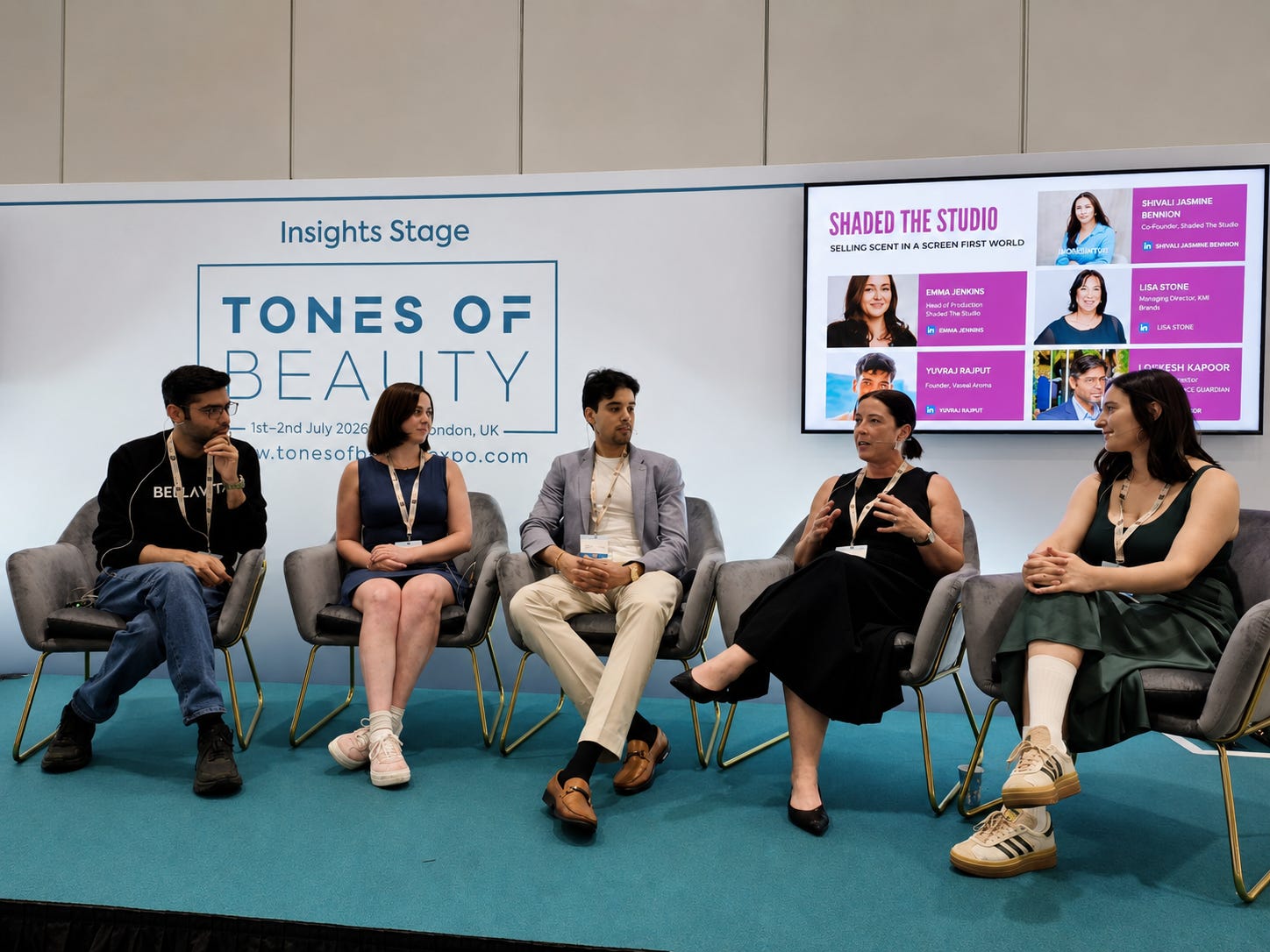
Fragrance brands can no longer rely on traditional retail models alone, with success now dependent on a strong identity, digital-first thinking and the ability to adapt quickly.
This was according to a Tones of Beauty panel discussion on July 1, moderated by Shaded Studio co-founder Shivali Jasmine Bennion and featuring KMI Brands managing director Lisa Stone, Bellavita co-founder Lovkesh Kapoor, Vasuki Amara founder Yuvraj Rajput and Shaded Studio head of production Emma Jenkins.
Digital-first growth
Stone, whose fragrance brands under KMI Brands have been built through traditional retail for more than 25 years, said brands must rethink their approach as digital platforms become a primary route to market.
She said: “There was no digital platform for us to launch on. We’ve had to build that success through retail. What that means is we’re now having to learn how to make that transition onto platforms like TikTok Shop and Amazon.
“The challenge is how do we recreate the experience customers had 20 years ago in a digital-first world?”
Meanwhile, Kapoor said the business has taken an online-first approach, arguing that digital must be embedded into a brand’s strategy rather than treated as an additional sales channel.
He said: “Our focus has always been to launch online, achieve a dominant presence online first and then go offline.
“The reality is that managing offline and online together is complex. Digital cannot just be another sales channel. The entire DNA of the business has to be built around it.”
Kapoor said success on TikTok depends on constant testing rather than assumptions about what will work.
He said: “The entire company has to become data-first. You’re looking every day at what’s changing, which creators are working, what content is resonating and what isn’t.
“We’ve seen creators with 1,000 followers generate a million dollars in sales for us in the US in one month, while creators with a million followers haven’t generated anything. The TikTok algorithm is still a black box, so you have to keep testing rather than assuming you know what will work.”
Jenkins said brands should focus on translating fragrance into visual stories rather than simply showcasing products.
She said: “We start by breaking the fragrance down into stories. You can’t put scent on a screen, so using ingredients is an effective way of communicating what a fragrance smells like through imagery.”
Stone added that even established brands are still learning how to maximise opportunities on platforms such as TikTok Shop.
She said: “We’re only just about to launch on TikTok Shop ourselves, so we’re learning a lot. I still think we’re only scratching the surface of what these digital platforms can do.”
Rajput said digital allows emerging brands to experiment quickly, but added that Vasuki Amara is focusing on mastering one platform before expanding further.
He said: “For a new brand, online is much easier to enter because you can change your marketing material quickly and learn what customers respond to. We’re focusing on one channel at the moment because we want to master that before moving elsewhere.”
Kapoor highlighted the importance of constant innovation in a digital-first market, arguing that brands cannot rely on a single successful product or campaign.
He said: “One thing that has remained true over the years is that the only thing that is really static in social media is newness. You cannot be boring. Your content cannot sound the same, your products cannot look the same, and your marketing cannot stay the same.
“You have to be planning what’s next while today’s success is still happening.”
Identity
Stone acknowledged that the fragrance market has become crowded, noting that when KMI launched its first Ted Baker fragrance in 1998 there were around 500 launches that year, compared with nearly 12,000 last year.
“The question for all of us is how we make sure consumers understand why they should choose our brand over the thousands of others launching into the market.”
She added that while digital has transformed how brands reach consumers, maintaining a clear identity remains essential.
She said: “Staying true to your brand DNA is essential because that’s why consumers buy into your brand. If customers don’t understand what the brand stands for and why that fragrance exists, then we’re just selling another fragrance.”
Rajput said creating a distinctive identity has been central to Vasuki Amara’s strategy, with the brand seeking to bring Indian heritage into the fragrance category.
He said: “As a startup, we really need to push a unique selling point because a lot of fragrance brands can seem very similar. I felt there was an opportunity to tell India’s story through fragrance and create an Indian fragrance brand that genuinely portrays that heritage.
“At the moment we only have one fragrance, but that’s intentional. We want it to be a statement fragrance with a strong history and story behind it.”
Scaling
The panel said scaling successfully requires discipline, with startups needing to balance growth ambitions against limited resources and customer demand.
According to Kapoor, businesses grow by responding to customer needs rather than becoming too attached to the founder’s original vision.
He said: “One thing startups often don’t do well is listen to the customer. Founders become so centred around their own thinking that they stop listening to what customers are actually telling them.
“The businesses that become large do so because they solve customer problems, not because they stick rigidly to what the founder originally believed.”
He added that startups must remain disciplined when resources are limited, carefully considering where to invest before reaching scale.
“At the startup stage you should always assume you have limited resources so you become disciplined about where you invest. Once you’ve achieved scale you have more resources; you can launch more products, work with more creators and market more aggressively. Ultimately, the only real competitive advantage in this business is scale.”
Stone noted the pace of product launches expected by consumers represents a challenge for brands built around traditional retail models.
She said: “Coming from a retail-first mindset, launching huge numbers of products sounds extraordinary because traditionally we’ve always worked with much higher minimums.
“However, consumers now expect far more newness than ever before. The challenge is understanding why that’s happening while balancing it against the realities of running an established brand.”
Rajput said Vasuki Amara is deliberately taking a focused approach to growth, prioritising learning before expanding.
He said: “Right now we’re deliberately focusing on one channel. We want to master that first before translating what we’ve learned across other channels. As a startup, it’s about learning quickly rather than trying to do everything at once.”
Jenkins added that brands should avoid making assumptions about what content will perform, instead using customer behaviour to shape future campaigns.
She said: “Just get content out there and test everything, because you don’t know until it is actually live. Your customers will tell you what’s worked and what hasn’t, so then you can build on that.”
Rise of dupes
Responding to a question from Arabian Beauty Business about the rise of dupe fragrances, the panel agreed that the category has gained significant consumer demand but questioned whether competing primarily on price can deliver long-term growth.
According to Stone, there is room for both dupe and premium fragrances, with lower-priced alternatives potentially introducing consumers to new fragrance categories before they trade up.
“There is also a huge group of consumers who will continue to buy into established brands. For younger consumers, dupes can even become their first introduction to certain fragrance styles before eventually moving into premium brands. I think there is room in the market for both.”
According to Jenkins, brands should focus on communicating what makes them distinctive, even when products occupy similar categories.
She said: “There could be similarities to another brand, but there’s something unique about both of them, so it’s just finding what that is and trying to transfer that through the imagery or the content.”
Kapoor added that dupes can offer a strong initial value proposition but argued that building a business around price alone is difficult to sustain as competition increases.
“If you’re trying to achieve initial scale, dupes are actually a strong value proposition because you’re offering customers something inspired by a £300 fragrance for around £30.
“The problem today is that everybody is doing it. One brand sells it for £30, another for £20, another for £15. Price competition is the lowest form of competition, and my sense is that building a business purely on dupes is no longer a sustainable strategy.”