
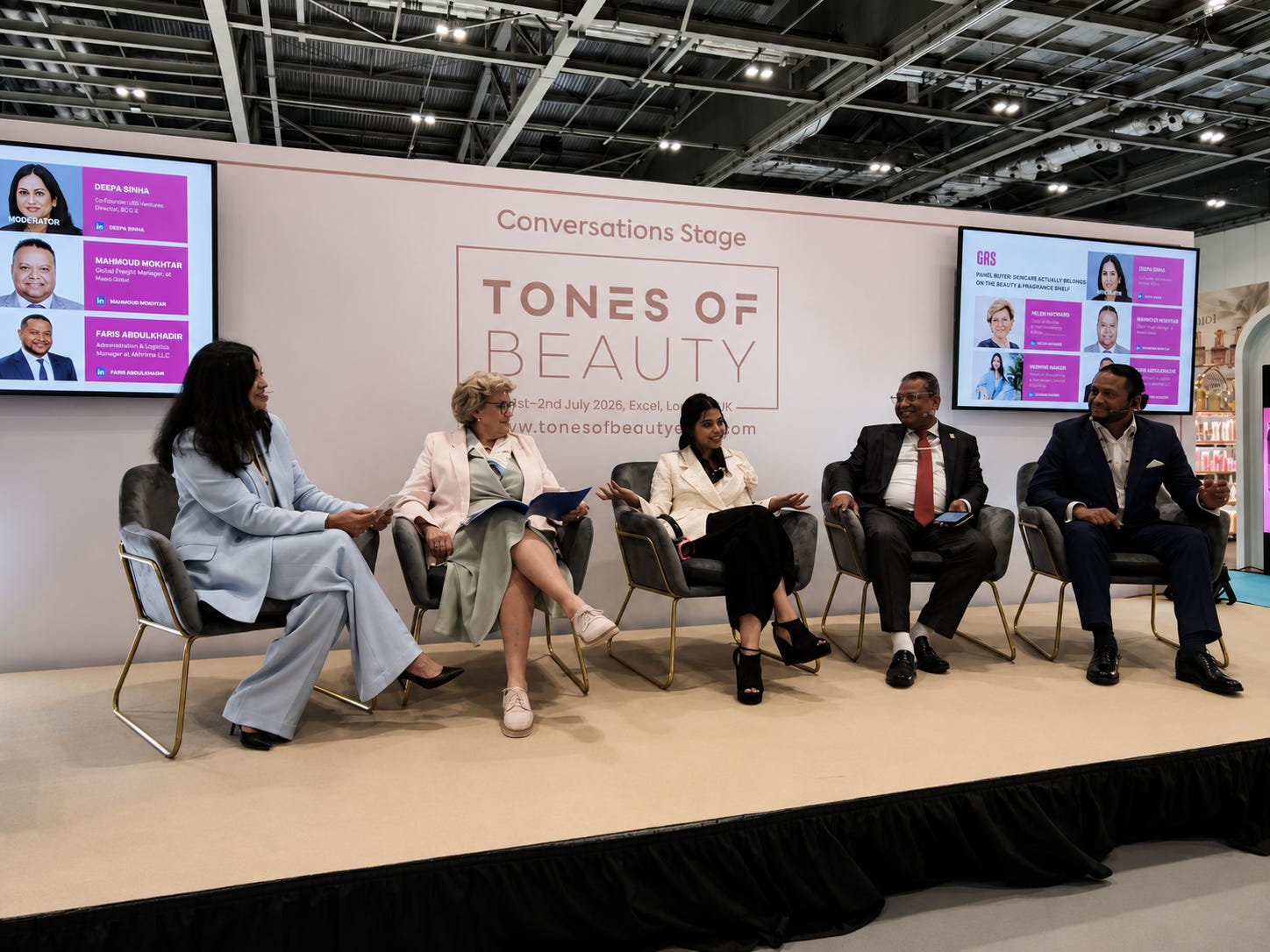
For fragrance brands seeking international growth, a great product is only the starting point. Commercial readiness, clear positioning, consumer understanding and the infrastructure to support sustainable growth can determine whether a brand secures the right commercial partners.
That was the key takeaway from a panel discussion at this year’s Tones of Beauty event. The panel featured International Luxury Brand Consultancy founder and managing director Valérie Kaminov, Sterling Perfumes (Armaf) global head of marketing Nayana Tharoor, Al Majed Oud global projects manager Mahmoud Mokhtar and Afak Trading LLC administration and logistics manager Faris Abdulkhadir. The discussion was moderated by compliance firm GCRS’ co-founder and technical director Deepa Sinha.
Beyond the product
Kaminov said founders should approach distribution as a methodology rather than simply looking for a distributor or retailer.
She said: “Distribution becomes a strategy, but it doesn’t become a guessing game. It’s a discipline, it’s an approach, and it also allows sustainable growth.”
She added that brands should enter buyer meetings with a clear understanding of their own proposition, the retailer’s business and how the partnership will create value.
“The fastest way founders can lose their credibility in front of buyers is to just walk into a room. They don’t know the market, they don’t have the knowledge, they don’t have the strategy.”
Tharoor added that brands should first establish clarity around their proposition before considering expansion.
She said: “I think it’s extremely important for me to understand why, what, how and to whom. There’s no point in releasing a product into the market without knowing the very basics. I think the foundation has to be strong, and that comes with clarity.”
Tharoor emphasised that a strong product is only the beginning of building a successful brand.
She said: “A great fragrance or a great product gives you your first purchase. But if you want a repeat purchase, you need to build trust. It’s a promise, and promises can’t be done in one day. There’s no easy 30-second answer.”
Comparing brand building to filmmaking, Tharoor said every department must work together to tell a consistent story.
She explained: “I actually see launching a brand like a movie. The movie is just not about the actors and what the final movie comes to. You have to have a script, you have to have a director, you’ve got to have a producer. You’ve got to invest and ensure that movie comes in line.”
Preparation
Abdulkhadir said preparation is essential when approaching distributors.
He said: “You can’t just sit there and say you want to do business. We have to have the right operation, compliance-wise, pricing-wise. You have to do the homework before getting into the market and before exposing yourself.”
He warned that approaching distributors before being properly prepared can damage a brand’s credibility and risk losing the confidence of potential partners.
Abdulkhadir said brands also need to demonstrate that they have the commercial capability to support long-term growth.
“As a distributor, I need to know what brand I am representing. I need to have a price list that is very competitive. I need to understand what your vision is for this product. Where would you like it to be?”
He said distributors need to understand a brand’s vision, including where the founder wants the product to be positioned, so they can identify the right opportunities and support its growth in the market.
International expansion
The panel also discussed the challenges of international expansion.
Kaminov said: “Being successful internationally doesn’t happen overnight. It happens because you have the right product, you have the right performance, you deliver what you say. It’s super important to make the first good impression when you enter a country.”
She urged founders to avoid applying a single formula across every market.
She said: “There is no copy-paste. There is not one formula that will work for every brand. The four Ps are purpose, perception, positioning and people. Nothing can happen without your team. Nothing can happen if you don’t know the positioning of the product in your market. Nothing can happen without the consumer.”
Tharoor highlighted the importance of maintaining consistent brand values while adapting communications to suit local markets. She said brands should retain their core identity globally but tailor how they communicate it based on cultural differences, market dynamics and consumer expectations. She added that global brands have a responsibility to understand and respond sensitively to the needs of each market.
Long-term growth
Tharoor explained that successful brands are built through collaboration across the entire business rather than by marketing alone.
“People only see what marketing rolls out at the end, but there is an army of people who work behind it, right from your new product development to your production partners, your sales team, your distribution network and your supply chain operation.”
She also emphasised the importance of supporting distribution partners after launch.
She added: “Building advocacy is constantly educating and training from the brand side. There has to be an active connection with the partners, constantly telling them what the guidelines are, what the story is, what format it is, training them to love your brand the way you love it.”
The discussion highlighted that successful brands need to build more than products. They need to understand their consumers and markets, establish strong commercial foundations and prepare for growth before the opportunity arises.