
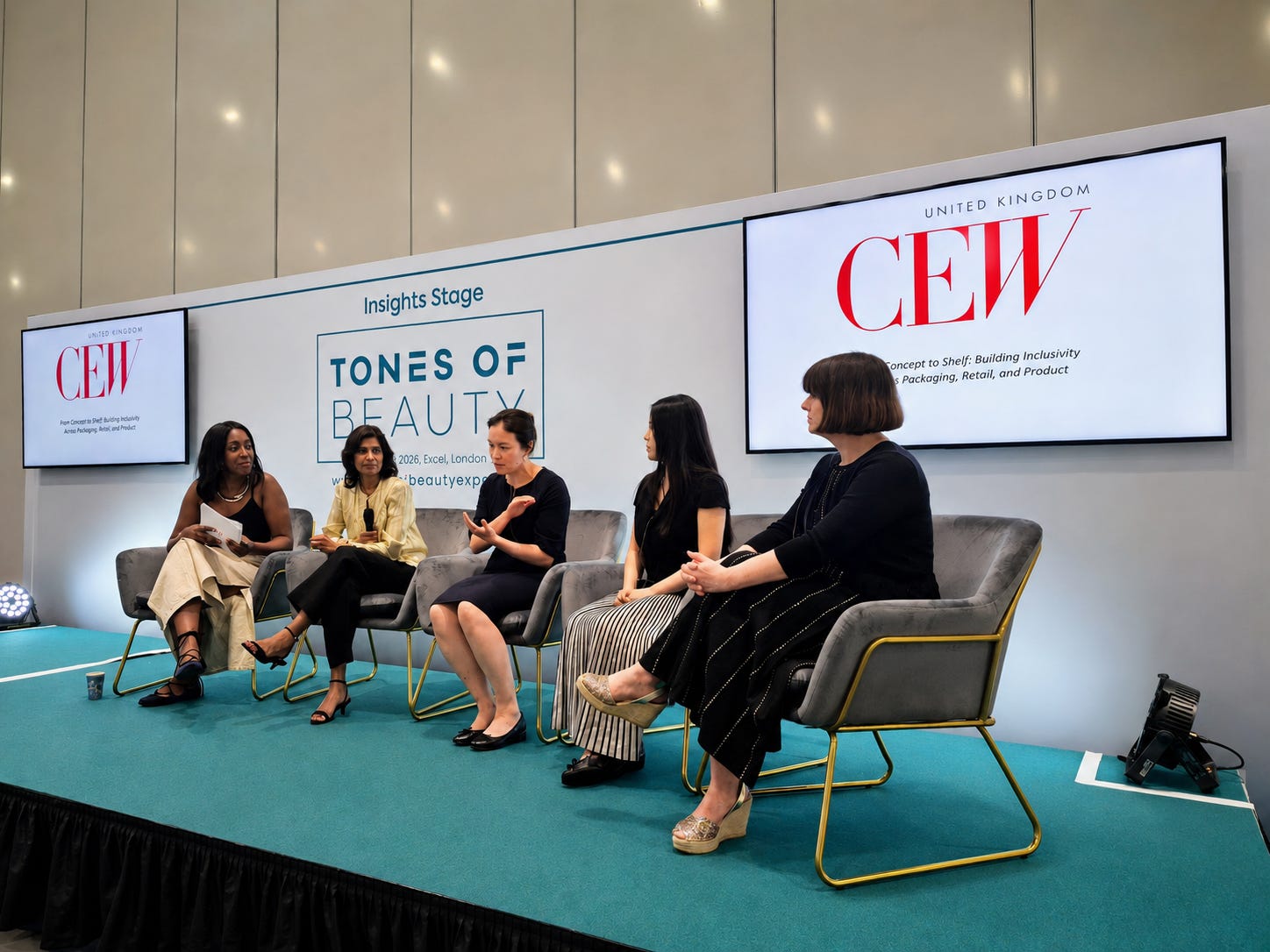
Beauty brands must embed inclusivity into every stage of the product journey, from concept and formulation to packaging, retail and consumer experience, to serve diverse consumers.
This was according to a Tones of Beauty panel discussion with Sephora UK VP of merchandising Jill Stutzbach, Skin Cupid founder and CEO Melody Yuan, Enkos Developments Limited founder and managing director Lorna Radford and Ruby Hammer cosmetics founder and director Ruby Hammer.
Intention
Hammer, who launched Ruby & Millie in partnership with Boots in 1998 following a two-year product development stage, argued that inclusivity should be an inherent part of a brand’s culture rather than something imposed from the outside. She said brands should naturally consider the needs of all consumers throughout product development, adding that inclusivity extends beyond skin tone to encompass age, disability, income and accessibility.
She said: “I think one of the most important things that you can have is your intention. Is it your intent to make it inclusive? Are you thinking that way? It has to be within you.”
Yuan also highlighted the need for intentionality when it comes to audience messaging around skin type, skin concern, skin tone, target consumers and the appropriate age group for each product.
Yuan said: “I think what’s really important for us when it comes to inclusivity is how you message the products and how you market all of these different products in the right way, so when you’re kind of talking about a serum or a cleanser or sunscreen.”
Radford, whose company creates bespoke beauty and personal care formulations, added that inclusivity isn’t a tick box.
She added: “We see a difference between brands who are leading with inclusivity, they’re leading with intention to target, solve a particular problem for a particular demographic compared to someone who might go, ‘Oh, by the way, it needs to be inclusive.’ What does that mean?.”
Consumer needs
Radford argued that inclusivity comes from designing products for specific consumer needs rather than attempting to create a one-size-fits-all solution.
She said: “For me the inclusivity is in diversity, so it’s making a really specific niche product where you know what your community is rather than trying to get a one size fits all, where actually everyone just feels a bit like.”
Yuan echoed this, stressing that brands should clearly communicate who their products are designed for, including the intended skin type, concern, skin tone and age group, rather than relying on generic marketing claims.
She said: “Don’t just kind of say, ‘Oh, this is a great serum,’ but what kind of skin type, skin concern, skin tone does this target?. I think it is really being intentional in how you’re messaging it.”
Hammer agreed, adding that brands should focus on delivering products with a clear purpose rather than trying to meet every possible need.
She said: “There isn’t one holy grail product that can tick every single box. You can’t be all things for people.”
Community feedback
The panellists also highlighted the importance of listening to consumers but at the same time, staying true to the brand’s vision. Yuan explained that customer feedback informs every buying decision at Skin Cupid. The retailer regularly communicates with its community before introducing new brands and products.
She said: “Every single one of those interactions feeds into our buying decision. We actually sent an email to our community for their opinion. Our community plays a massive part in how we bring out new brands and new products.”
Hammer agreed that feedback is invaluable but warned founders against simply giving consumers exactly what they ask for.
She said: “Every bit of feedback is important, but if I only gave them exactly what they want, they’d never see the part of the creative where my perspective differs from theirs. You have to be very brave and stand true to who you are.”
Radford noted that having a clear product brief helps founders stay focused on their original vision rather than becoming distracted by conflicting opinions.
She said: “It’s quite nice having that product brief to look back on. Why have I started this to begin with, to not get lost in the noise?”
Retail’s role
Stutzbach, a merchant, said she reminds herself that she is not always the customer or the demographic, and instead focuses on catering to certain demographics that feel marginalised. She mentioned that she had previously been evaluating a brand to launch in the market, but the feedback from her team wasn’t positive.
She said: “It doesn’t matter if I would use them or not use them. There’s a myriad of products that are available for me that are accessible for me and easy for me. I already have the privilege of having a broad assortment to choose from, so sometimes we need to think as merchants about picking products that aren’t for us, but for somebody else, especially certain demographics that feel marginalised that don’t have very broad assortment available for them.”
She also said that Sephora stocks over 3,000 shades of foundation that we carry but do not sell. She reiterates that retailers must intentionally choose to carry that range, and for Sephora, she emphasises that “it’s super important that anybody that comes into Sephora can find a shade that works.”
She added: “Representation really matters. It matters at every level of the organisation.”
Progress
Hammer said today’s beauty market offers consumers an “overwhelming choice”, fuelled by social media and ecommerce, making it harder than ever to know “where do I actually want to put my money?”
She urged brands to move beyond lip service and instead build genuine inclusivity into every aspect of product development, education and retail. Hammer also argued that the industry’s focus should remain on creating equal opportunities and ensuring beauty professionals are equipped to serve all consumers, regardless of skin tone, hair type or age.
The panel agreed that the industry has made significant progress on inclusivity, but that there is still considerable work to do. Yuan said success would come when inclusivity is so embedded in product development that it no longer needs to be singled out as a discussion point, while Hammer said the industry must continue to pass on its knowledge to future generations to keep driving progress.
Stutzbach added: “Success looks like everybody feeling included, everybody feeling that sense of belonging, and everybody feeling beautiful.”